
Here at Lift Up My Eyes, we make a practice of giving other Christian ministries an opportunity to submit a guest blog in order to help further their mission in the Kingdom. If you are aware of such a ministry feel free to have them contact me. The ministry focus must be compatible with what I am trying to accomplish. The blog is for the Glory of God. The articles I will include here are designed to help us keep our eyes cast upward, focusing on our Lord and Savior. 

Today’s guest blog is from Joan Borton, co-founder of Luke 14 Exchange, Inc., along with her husband Jerry. Jerry was born with Cerebral Palsy but hasn’t let that disability slow him down. Through the organization Jerry and Joan devote their time to helping people with disabilities, allowing them to make a positive impact on the world. Its mission statement includes the following “Everyone is a leader, including people with disabilities. We have had much to overcome. In doing so, we are honing our leadership by which we can change the world.” The two have been married since 1995. Joan has always been passionate about encouraging those who are disabled and their caregivers. She recently published her first book MarriageAbility: Embracing the Richness of a Marriage Affected by Disability (Available on Amazon including Kindle Unlimited). Hospitality is important to both of them.

I have served as Treasurer of Luke 14 Exchange almost from its inception, and  in that time, the Bortons have become great friends whom I love and respect. As an example of their hospitality when Heather and I were first dating, our first “public” event was being invited to their home for Easter dinner.

______________________

Who doesn’t love a magnificent feast? A banquet table filled with favorite foods and new delicacies in lavish supply. There is a banquet I look forward to even more than Thanksgiving or any other bountiful spread. And that’s sitting at God’s eternal banquet table in Heaven, with him as the host. I can’t wait to look around the table and see people I’ve known throughout my life, and many, many more I’ve never met. I’ll see people from every race, culture, socio-economic status, and educational background.
How do people know they’re invited to a banquet? They receive an invitation. Perhaps through mail, email, on social media, or even in person. Luke 14 Exchange, Inc. exists to invite people affected by disability to God’s table, where there is always room for one more. But some who receive an invitation decline acceptance or make excuses.

Like the parable told in the New Testament Gospel of Luke, chapter 14 (verses 16-24), the Banquet Master tells his servants to go out into the towns, the alleys, essentially the places where people rarely get social invitations. Find those who live on the margins of society, not in the mainstream, and invite them. “Then the master told his servant, ‘Go out to the roads and country lanes and compel (emphasis added) them to come in, so that my house will be full’.” Luke 14:23. Compel is an interesting word to use when issuing an invitation. It removes the option from the answer. Compel means to make the invitation so irresistible, so attractive, that it’s impossible to turn down.

This is not a one-and-done activity. “Oh, I invited those neighbors to church, but they didn’t want to come.” Compel implies a continuous sharing of life, the good news of Jesus Christ, and the joy that is found in a relationship with him, until someone can’t help but want to know more.

How does Luke 14 Exchange (L14E), a non-profit ministry now in its sixth year, do this?

In the United States, the estimate is that sixty-one million adults live with a disability. That is approximately one in every five people. If you look around your faith community, are twenty percent of your congregation people with disabilities?
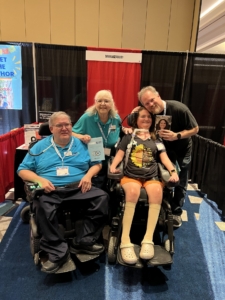
Most would have to answer “no” to that question. This is where Luke 14 Exchange comes in. We mentor and coach people with disabilities. Everyone has gifts and talents given to them by our Creator. We seek to help people find and develop these gifts and use them in the Kingdom of God. We encourage families affected by disability. We understand that disability impacts every member of the family. Sometimes these loved ones need someone to talk with, pray with, or simply listen to them. At other times, they need help finding resources or brainstorming ideas.

We partner with other ministries and churches to grow and develop their disability outreach. L14E’s services are offered without charge. Generous donors fund the ministry because they, too, believe in inviting people affected by disabilities to come to God’s table. We work with people face-to-face in central Florida and at two camps in eastern Tennessee. We also meet with people around the country through Zoom and phone calls. One of the unique factors of L14E is that we don’t just study disability to know how to interact and reach people. We live it! Seventy-five percent of both our staff and board are people with disabilities or live with family members who have disabilities. This means we have decades of experience from many viewpoints. We love meeting and talking with people from any size family, with any disability. As we seek to follow the command to “compel them to come in so my house is full,” it means that we need to identify with people where they are . We share their pain or challenges. We seek to help them with their immediate need—whether that be to secure a certain piece of equipment or service. After all, disability is relentless. We can’t take a vacation from it or put it aside for a few days. That is exhausting.
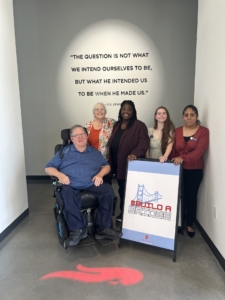
But the great news we get to share with people is that there is something else even more relentless than disability. That is hope! And hope’s name is Jesus! To learn more about Luke 14 Exchange, or to volunteer your time, visit our website at Luke 14 Exchange . We also invite you to follow our Facebook page. We welcome phone calls at 863-940-3816.

____________

To learn more about a new life in Christ, click here

Today I want to introduce you to a friend of mine, Robert Day. He states “My foster family called me Robbie, my relatives knew me as Bobby, and legally, I was Robert. I endured a childhood marked by deep generational poverty, abuse, and neglect. As an adult, I dedicated my career to understanding and transforming these experiences for other children. My journey has given me a compassionate and comprehensive, 360-degree perspective on orphan work – what the system refers to as child welfare.” Out of this background, he founded Recovering Orphan.

Robert is the first in what I hope is a series of guest bloggers who are reaching out to my readership, informing you of their non-profit ministry. For more information about Recovering Orphan go to https://recoveringorphan.org/ or email Robert at Rday@FIVE18.org.

_____________________________________________________________________

“Hi, everyone. My name is Robert Day. I am a 63-year-old recovering orphan. I’ve gone twelve days without feeling rejected, lonely, or unloved.” If this was a meeting of Orphans Anonymous, or OA, this is where you would say, “Welcome, Robert!” Of course, there’s no such thing as OA, but with as many anonymous orphans as we currently have in this world, perhaps there should be.

I was born an orphan; I grew up an orphan. In fact, I was the first child of fifteen orphans born to my two parents, who also were orphans. Throughout my childhood, I was treated as an orphan. I spent time in foster care and was rejected by my birth parents over and over again.

A parent’s rejection is probably the deepest and longest-lasting wound a child can suffer. Boy, did my mother do a number on me! Her lifetime of serial rejection—from my birth to her death—defrauded me of something most people take for granted: to live securely in the knowledge that your parents love you and have your back. My father is guilty as well, maybe more so, but for some reason my mother’s rejection hurt a whole lot more.

Thus, I have lived a good portion of my adult life carrying the wounds of an orphan. Though there has been substantial healing along the way, I still occasionally struggle to vanquish the natural consequences of my orphan injuries. In many ways, I still have an orphan spirit: feeling, among other ways, abandoned, angry, fearful, hopeless, worthless, mistrusting, and manipulated.

“But wait!” you might say. “You had two parents. How can you be an orphan?” It’s true, the word “orphan” conjures up images of children in uniforms, marching in lines, eating gruel in dank, dark Victorian or Great Depression-era orphanages. Like Oliver or Annie, but without the singing. Orphans are children whose parents die in war or of famine or plague, or children left by roadsides with a note pinned to their chests. It’s true, there was a time in this country when orphans were easily identifiable, carrying their shame like a badge. There also was little doubt or debate that these children needed services and care. Nor was it ever questioned that the Church—the Body of Christ—should take an active role in their care. Those once-visible orphans have been replaced by invisible ones.

Here’s the truth: Not every orphan is an orphan. And not everyone who is an orphan realizes they are one. Let me explain.
First and foremost, we must understand that the main issue at hand is vulnerability. A child, by nature, is vulnerable. Children who are missing parents—for whatever reason—experience another level of vulnerability altogether. Children come into the world, the procreation of two people—a man and a woman, a mother and a father—and are raised by a member of both sexes. They learn from and can, thereby, relate to both, as well as be blessed by both. That’s the ideal situation. Of course, not every child has the ideal situation.

Think of it like this: Growing up without one of your parents is like missing an arm or a leg. It doesn’t make you less of a person, but it does make it harder to navigate certain aspects of life without help.

Using three sources of authority, Orphan is defined here to be a minor child missing one or both parents.

The Bible—In the Scriptures, the words “orphan” and “fatherless” are interchangeable, meaning a child only needs the loss of one parent to be an orphan.

Orphanages—Children in these institutions were called orphans. Sometimes they were recorded as half-orphans or double orphans—even by state officials—in order to distinguish how many parents were absent. Approximately 85–95 percent of all children in the history of the orphan asylum movement had at least one living parent, usually the mother. From a biblical perspective, they were fatherless children.

UNICEF—An arm of the United Nations and their global partners, UNICEF has a similar system to that of the old orphanages. It defines an orphan as a child under 18 years of age who has lost one or both parents to any cause of death: Maternal orphan, a child whose mother has died. Paternal orphan, a child whose father has died. Double orphan, a child who has lost both parents.

So, what are the circumstances that make a child an orphan? UNICEF includes only death in their definition, but because vulnerability is at the center of our concern, we expand the causes to include nearly any circumstance where at least one parent is not involved in the life of the child. They include the seven D’s:
Death—self-explanatory
Desertion—abandonment
Dissolution—parental rights terminated
Detainment—long-term incarceration
Disappearance—whereabouts unknown
Disaffection—estrangement, alienation, apathy
Dysfunction—family impairment that results in neglect, abuse, or exploitation

The orphan spirit doesn’t care about what makes a child an orphan—legal, official, or otherwise. In fact, I would argue that a child who is missing a parent because of death—as terribly hard as that can be—is potentially in a better place emotionally than a child who has a living parent who is absent, or worse still, present and abusive. A child rejected by a living parent is deeply wounded in ways that a child who loses a parent by death is not.
Once you are open to this more-inclusive definition, you will suddenly see orphans everywhere. I venture to say there are more orphans in America today than we’ve ever had in our history, even during periods of war, disease, and economic turmoil.

Now that you’ve taken the first, crucial step in understanding who, or what, is an orphan, let’s define a widow. Like an orphan, a widow has become narrowly defined. It most commonly refers to an older woman whose husband has died. Certainly, those women should be seen and served as those who are vulnerable. However, in the Bible the word widow is almost always associated with the word orphan.

Remember, vulnerability is the concern of God in these verses. If a spouse has died, the surviving spouse is a widow, or if male, a widower. If this happens while their children are still young, we would call them orphans, and the Christian community would rightly rally around them.

Now, let’s expand the concept a little further. If a person—usually a woman—is the parent of an orphan, wouldn’t that make her a widow? This may be a bit more difficult to comprehend, or perhaps to accept, but it’s exactly why orphanages failed to properly serve the orphaned. They gladly received children into their institution, whose fathers were absent for whatever reason, but often did little to help the mothers. Their narrow definition overlooked the full will of God in those situations. If they had helped the widow—we call them single mothers today—her orphan children would automatically be the beneficiary of that help too. By serving only the orphan, orphanages neglected the most important need of their residents: family. If we can accept the broader and more historical definition of orphan, for practical reasons alone, we must then embrace the more inclusive definition of widow as well. It’s the very best way to help both.

OK, is your brain tired yet? Well, we can’t stop here. There’s one more thing to consider—one more step we need to take in our quest to grasp the full boundaries of the orphan universe.
If a child who grows up without a parent is an orphan, that doesn’t necessarily change once they become legal adults. For the rest of their lives, they will never have that parent. Yet, they’ll always carry the wound—an inner vulnerability, if you will. In other words, the limb is permanently missing. I call these adults “recovering orphans,” and like a recovering addict, no matter how old they become or how much healing they enjoy, they’re only a situation, a temptation, or a circumstance away from giving in to the old spirits of orphanhood.

The issue is no longer just about the vulnerability of a minor, but also the volatility of an adult.

Sign Up for New Post Notifications!